

GROW YOUR PRACTICE
Every practice has
a referral network.
Few have a plan for it.
Referral Intelligence tracks how your referral relationships are performing, asks your referring dentists what they actually want, and turns both into a short weekly plan. Every recommendation shows the reasoning behind it.
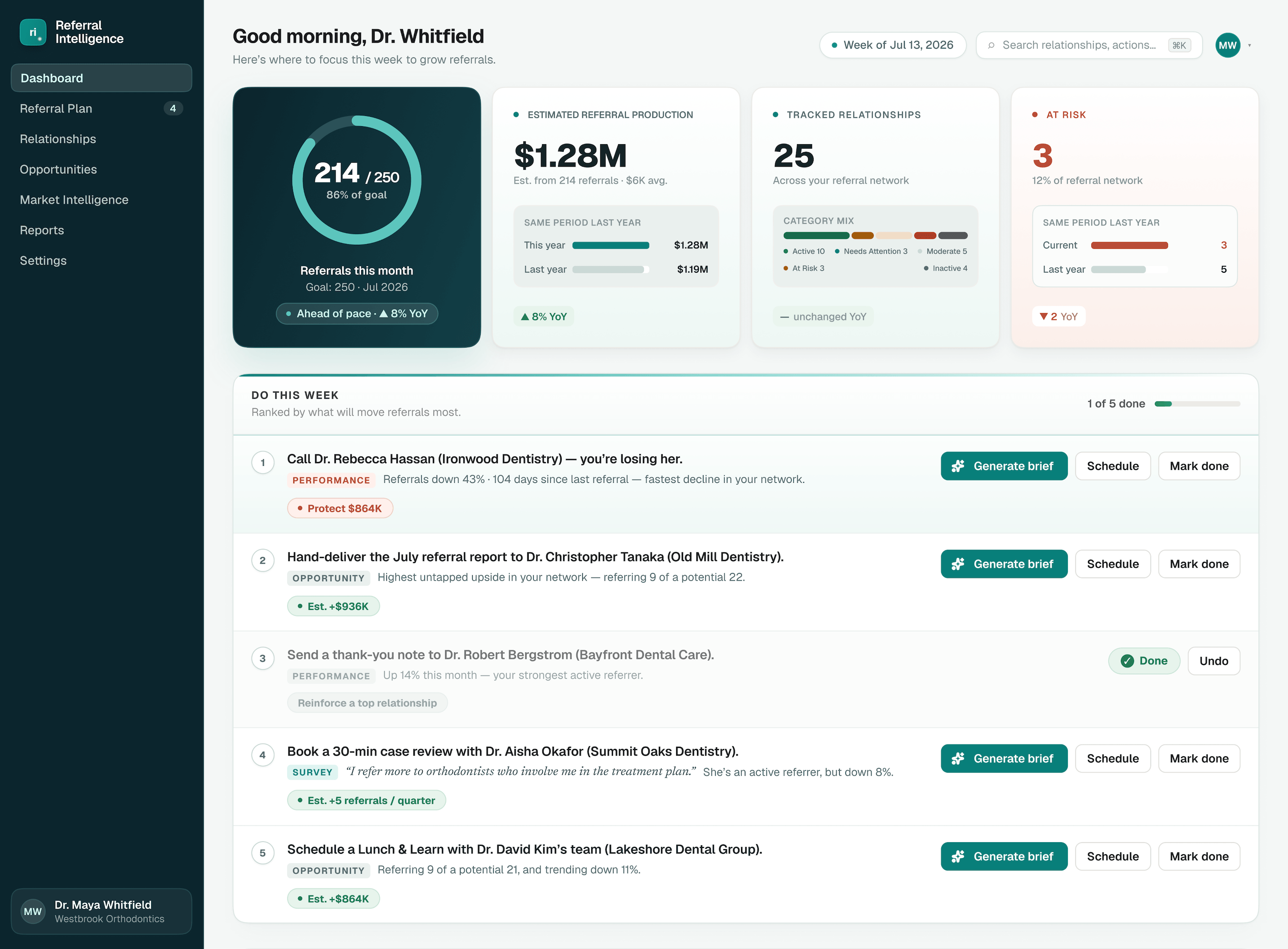
Built for orthodontists, oral surgeons, endodontists, and the specialties that grow by referral.
THE STAKES
Your largest source of new patients is a set of relationships nobody manages.
General dentist referrals are the single largest source of new patients for most specialist practices — larger than search, social, and paid advertising combined. For some specialties it isn't one channel among several; it's the whole channel.
35–40%
of new patients come from general dentist referrals — the largest single source
90%
of root canals performed by endodontists originate from a referral
$60,000–$200,000
annual production from a single referring office
AAO and Levin Group survey data, 2025 · AAE 2026 Endodontist–General Dentist Referral Patterns Survey · Levin Group / Orthodontic Products Practice Survey
THE PROBLEM
Plenty of activity.
No system.
Lunches get bought. Gifts get dropped off. Offices get visited when somebody has a free afternoon. Referrers get sorted into A, B and C lists that were set years ago and never revisited. And almost nobody can say which activity produced which referral.

No system
Referral marketing runs on memory and goodwill
01
No priorities
Effort goes where it's convenient, not where the opportunity is
02
No measurement
Nothing connects an activity to a referral, so nothing improves
03
No consistency
The offices that need attention most often get it least
04
THE COST OF NO SYSTEM
THE REFRAME
Maybe dentists aren't finicky.
Ask most specialists about their referral base and you'll hear a version of the same thing: dentists are unpredictable, loyalty is fickle, referrals come and go for reasons nobody can explain.
Turn the question around. Over the past year, how consistent was your practice with each referring office? For most practices, attention is reactive. Some offices get lunches, notes and case discussions. Others go a full year without hearing from anyone — and nobody notices.
That's not a dentist problem. It's the absence of a system.

65%
of endodontists report losing at least one referring dentist in recent years.
80% report gaining one. The base is in constant motion, and most practices only notice the losses in hindsight.
AAE 2026 Endodontist–General Dentist Referral Patterns Survey
HOW IT WORKS
Three questions, answered every Monday morning.
How is my practice doing?
Referrals against goal, estimated production, active referrers, and how many relationships are slipping — in one view, updated as referrals arrive.
01
Who needs attention?
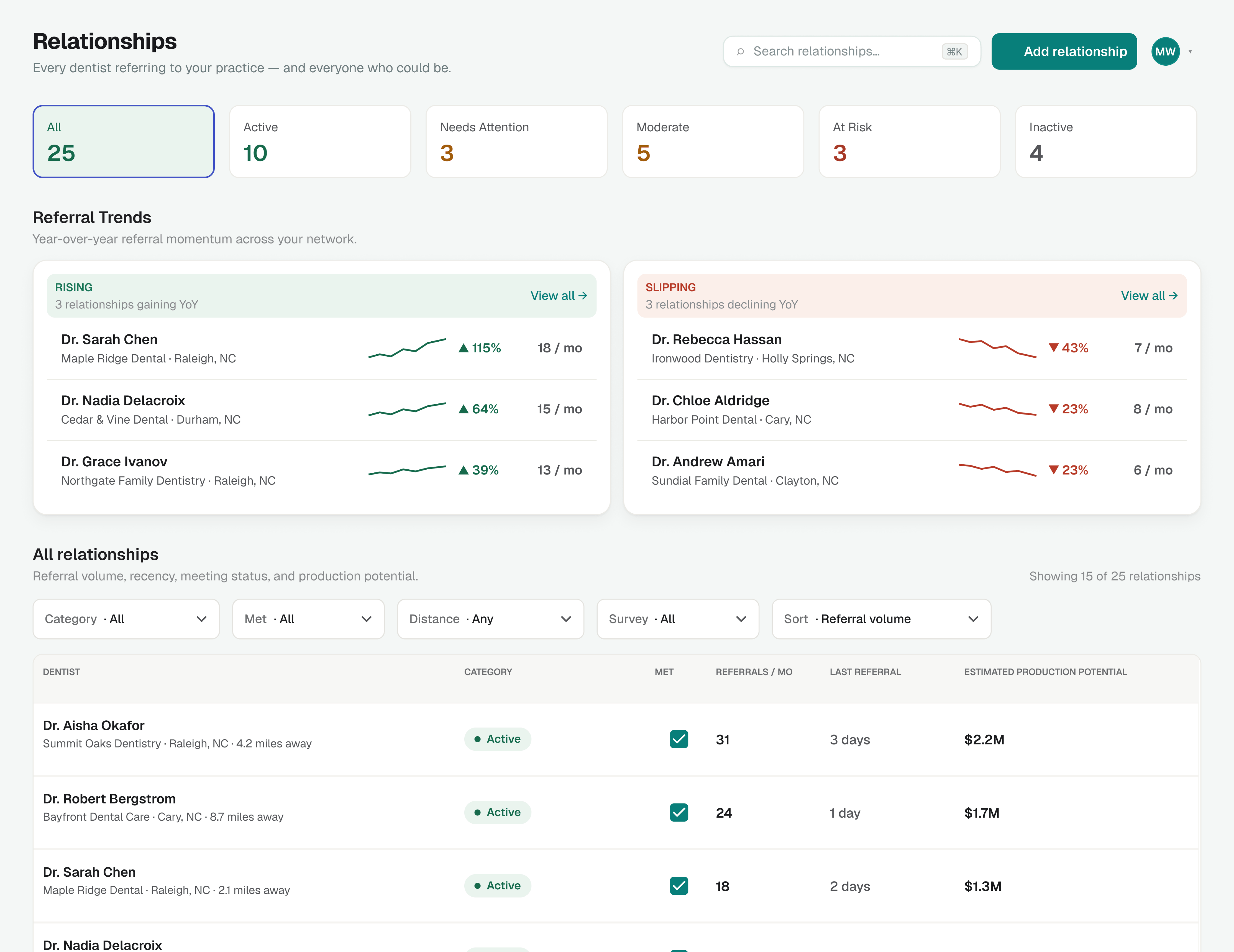
Every referring dentist ranked by what's actually happening: referral recency, trend, distance, and untapped potential. Relationships that are slipping surface before they're lost.
02
What should I do next?
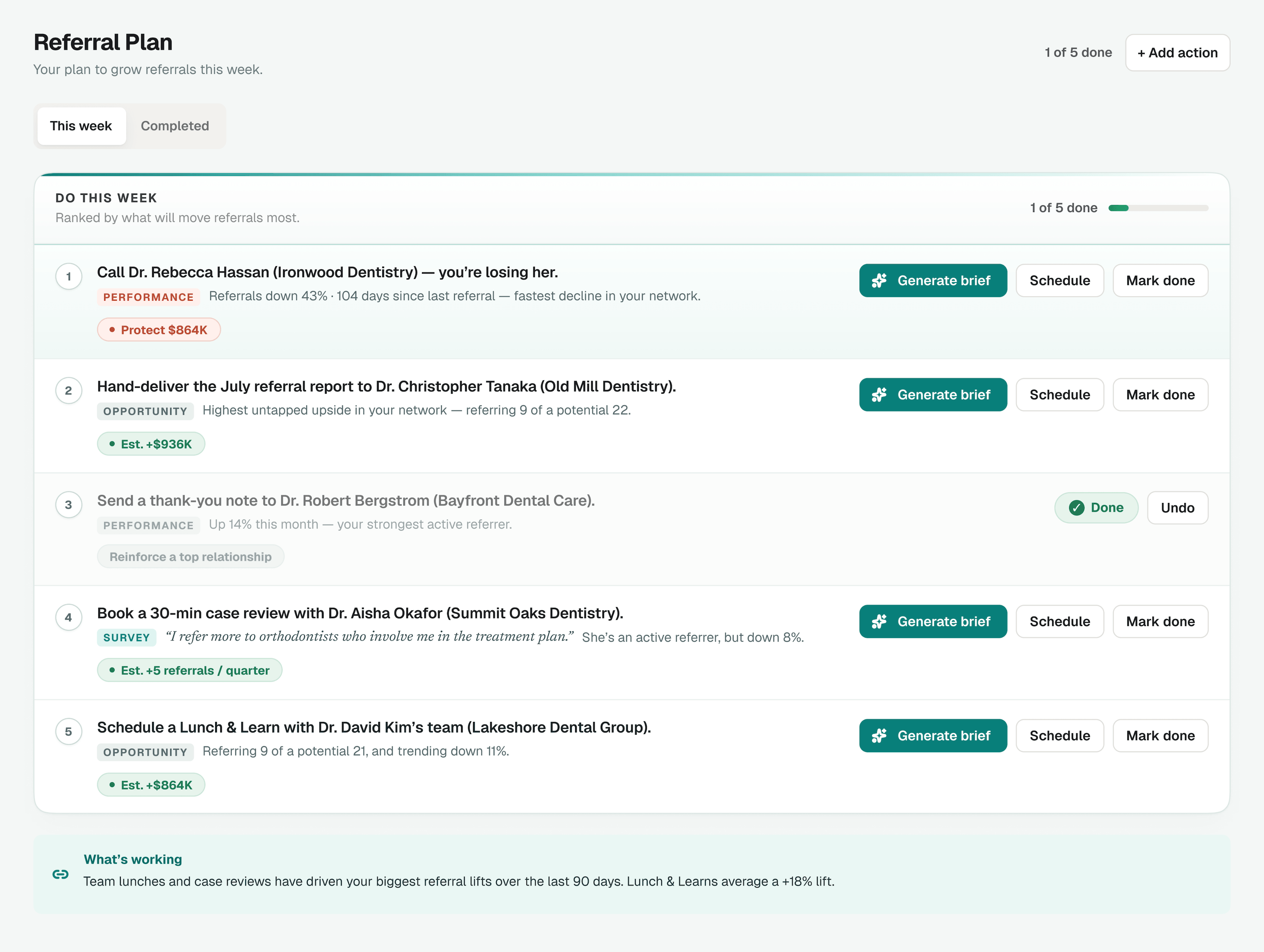
A short weekly plan — a handful of specific actions, each naming the dentist, the signal that generated it, and the expected impact.
03
YOUR WEEKLY REFERRAL PLAN
A plan, not a task list.
A small number of actions each week, ranked by what will move referrals most. Each one names the dentist, states the signal behind it, and estimates the impact. Complete an action and the system tracks what happened to referrals afterward — so the plan gets better at knowing what works for your practice.
Every recommendation cites its source: a performance signal, or something the dentist told you directly.
ASK YOUR REFERRERS DIRECTLY
Stop guessing
what your referring dentists want.
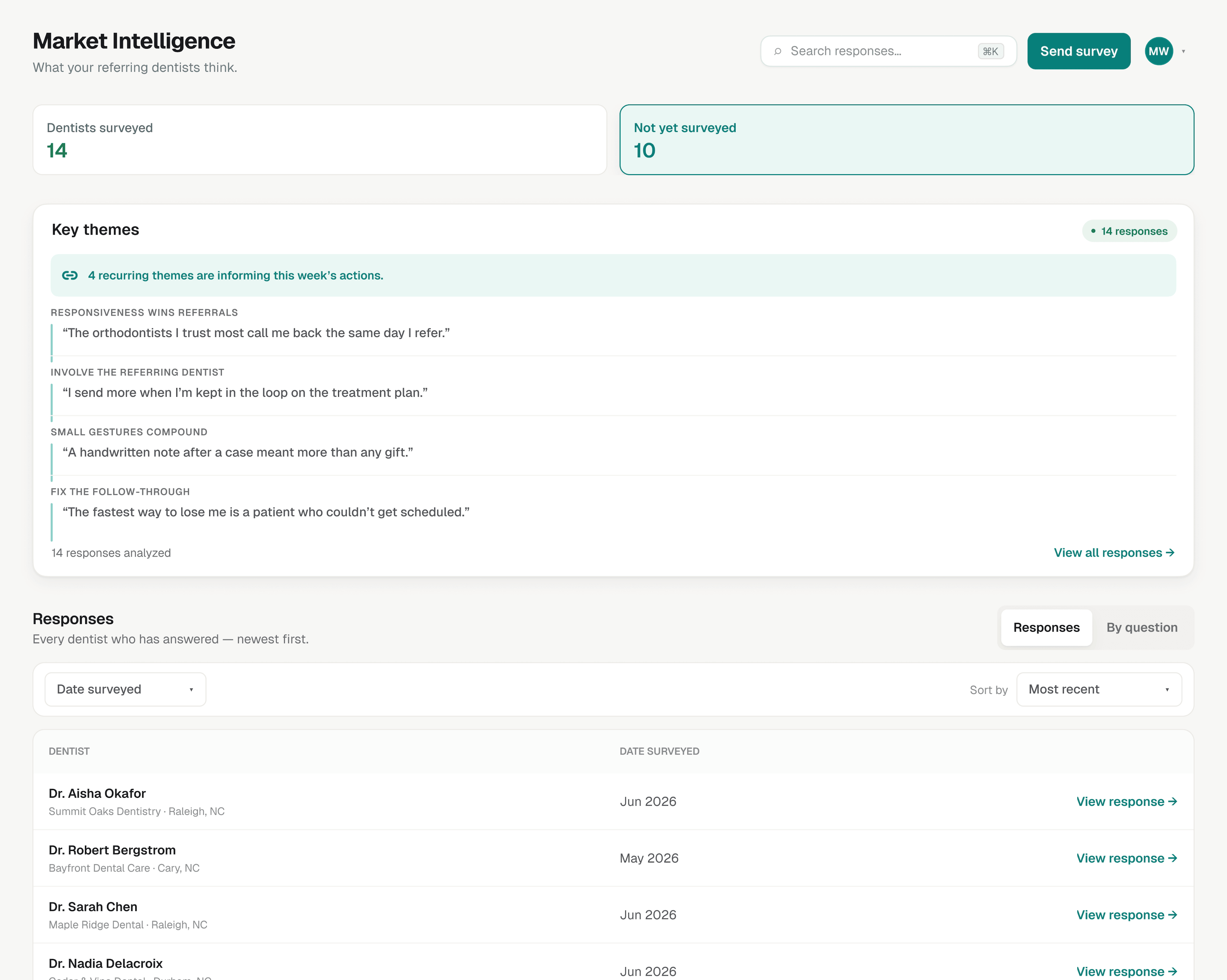
Referral Intelligence surveys the dentists in your network with a short, personalised questionnaire, then turns the answers into themes, individual profiles and specific actions. It captures referral barriers, communication preferences, and who's open to a visit, an educational event or a conversation.
Answers become actions. Openness to a lunch becomes a scheduled lunch.
KNOW EVERY DENTIST BEFORE YOU WALK IN
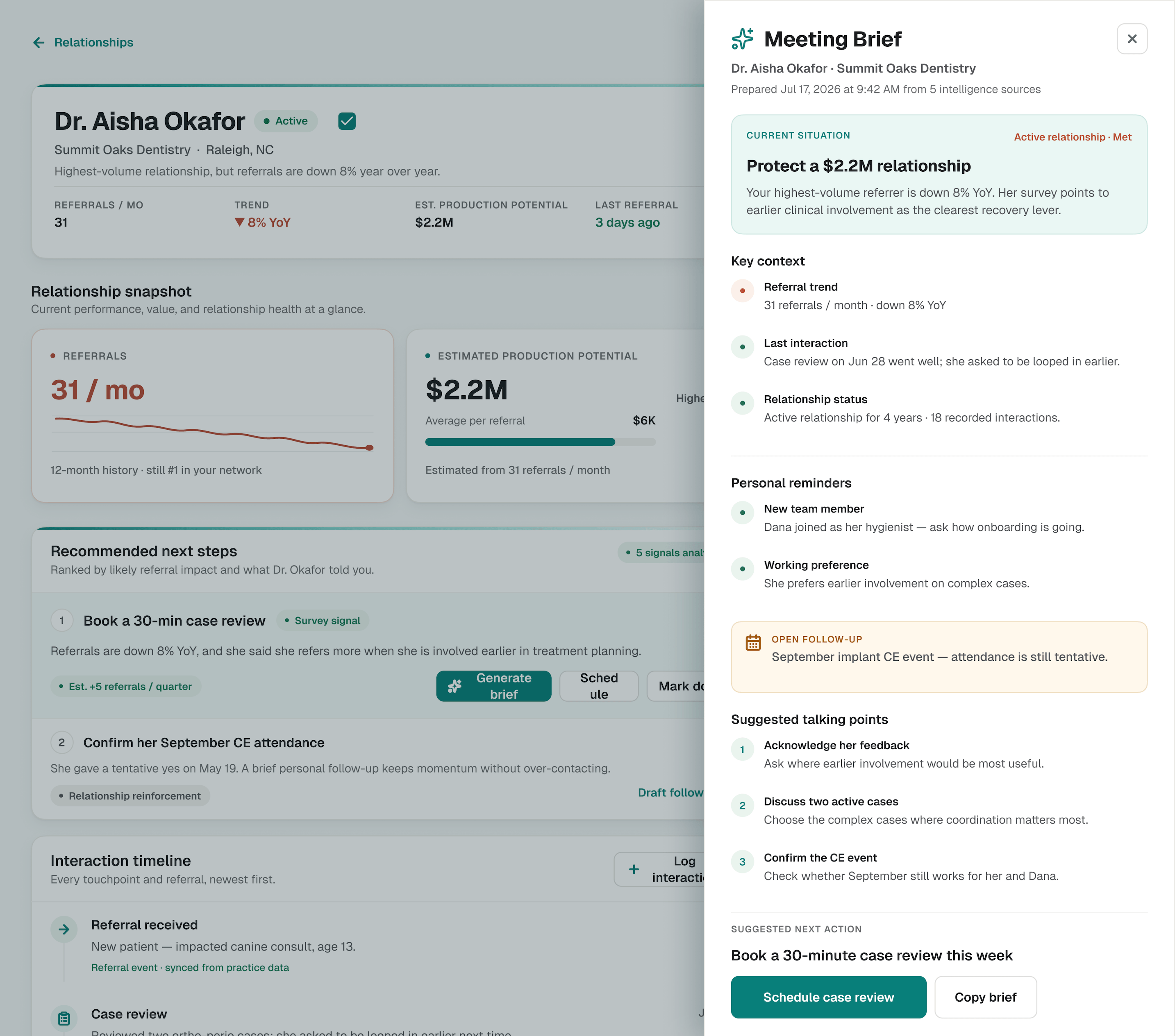
A living profile for every referring relationship.
Referral history, survey answers, every interaction, personal details, open follow-ups. One click generates a meeting brief with the current trend, the last conversation, what they've asked for, and what to say next.
EVERY DENTIST IN YOUR AREA
Your network is bigger than your list.
Every dentist identified by NPI — the federal provider registry — with exact mileage from your practice. Filter by 5, 10, 25 or 50 miles. Track who you've met separately from who refers, so prospecting and retention stay distinct.
The office three miles away that has never sent you a patient is worth knowing about.
A DIFFERENT JOB
Referral tracking tells you what happened.
This tells you what to do.
Most referral software is built to move a referral from one office to another without losing it — secure transmission, status updates, patient follow-up. That's useful, and it's a different job.
Referral Intelligence starts one step earlier, with the question that determines whether the referral happens at all: why does this dentist send you patients, and what would make them send more?

Referral tracking software
- Manages referrals you already received
- Tracks a patient through a pipeline
- Tells you what happened
- Built around a transaction
Referral Intelligence
- Grows the number you receive
- Tracks a relationship over years
- Tells you what to do next
- Built around a relationship
FOR YOUR SPECIALTY
Different specialties.
Same dependency.
Orthodontics
General dentist referrals are the largest single source of new patients, and the relationship is built over years of shared cases.
01
Oral & maxillofacial surgery
In one study of how general dentists choose a surgeon, the top-ranked criterion was the personal and professional relationship with the specialist. Ahead of every clinical and practical factor.
02
Endodontics
Around 90% of endodontist-performed root canals come from referrals, and general dentists perform roughly 70% of root canals themselves. Every case that reaches you is a decision made in someone else's office.
03
THE SYSTEM APPLIES
THE EVIDENCE
The case for this isn't our opinion.

83%
of general dentists want the specialist to tell them when treatment is complete
Peer-reviewed survey of general dental practitioners, 2025
65%
of endodontists have recently lost a referring dentist
AAE 2026 Referral Patterns Survey
#1 factor
in choosing an oral surgeon is the personal relationship with them
Journal of Oral and Maxillofacial Surgery
35–40%
of specialist new patients come from general dentist referrals
AAO / Levin Group, 2025
FAQ
Questions before the demo.
Does this replace my practice management software?
No. Referral Intelligence sits alongside it. Referral data comes in from your practice management system or by upload, and everything else — relationships, surveys, weekly actions — lives here.
01
How do the dentist surveys work?
You send a short questionnaire to the dentists in your network. It's branded to your practice, takes 5–10 minutes, and asks what would earn more of their referrals, how they prefer to be contacted, and whether they're open to a visit or an educational event. Their answers feed directly into your weekly recommendations.
02
What if I've never tracked referrals before?
That's common. Referral Intelligence can start from an upload of your existing referral history, or from a connection to your practice management system, and builds the picture from there.
03
How much time does it take each week?
You choose. Most practices set one to two actions a week during onboarding. The plan is sized to the capacity you tell it you have.
04
Which specialties is this for?
It's built for any specialist practice that grows by referral — orthodontics, oral surgery, endodontics, periodontics and others. The recommendations adapt to how your practice actually operates.
05
SEE YOUR NETWORK
See what your referral network actually looks like.
A short demo, walked through with your own network in mind.
No commitment. About 20 minutes.